Key Takeaways
Decisions made early in tool design affect part cost, quality, and uptime for the life of the program.
BRI matches each tool to the part, resin, estimated annual units (EAU), expected program life, and any anticipated design changes or program growth.
Engineering tooling reviews, in-house mold-flow simulation, and “steel-safe” design help resolve risks before and after steel is cut.
BRI sources production molds from a vetted network of tool builders in the U.S., Canada, and Asia, built to BRI’s specifications.
BRI’s in-house tool room maintains hundreds of customer molds each year to protect part quality and reduce unplanned downtime.
Tooling is usually the earliest, and often the largest investment in an injection molding program. How the mold is designed and built affects part cost, quality, and uptime throughout the program. At Blue Ridge Industries (BRI), we start by matching the tool to the part, resin, estimated annual units (EAU), expected life of the program, and any anticipated future design changes or program growth.
What Is Injection Molding Tooling?
Injection molding tooling (commonly just called “the mold”) is used to form plastic parts. During each cycle, molten resin is injected into a cavity machined into the mold. The resin is held under pressure by the molding machine as it cools, and the finished part is then ejected.
To carry out that cycle, a typical mold combines a cavity and core with systems that deliver resin, remove heat, vent air, and eject the finished part. Undercuts and side features are formed by slides or lifters. Slides can be driven by angle pins or hydraulic cylinders. In a hydraulic core-pull system, the cylinder moves and retracts the core(s). Molds with these moving parts are called “action” molds.
Molds also differ in the number and mix of parts they produce per cycle. A single-cavity mold produces one part, while a multi-cavity mold produces several identical parts. Cavity counts often follow powers of two (e.g., 1, 2, 4 … 64) because that layout allows a naturally balanced runner. BRI currently runs molds with up to 64 cavities. A family mold produces related parts in the same shot. A 1+1 mold produces 2 parts per machine cycle, but their geometries differ. A 2+2 mold produces 4 parts per machine cycle, 2 of one geometry and 2 of another.
What Determines the Right Tool?
Successful tooling consistently produces parts that meet dimensional and cosmetic requirements at the cycle time assumed in the quoted part cost. Key decisions include:
Volume and Product Life: Expected program life in years, EAU, material, and required part cost drive early tooling decisions. More cavities increase output per cycle but add upfront cost.
Resin and Tool Material: Resin properties such as shrink, melt flow index (MFI), abrasiveness of fillers, and corrosivity (e.g., PVC) influence steel selection and mold design. The reinforcing fibers of glass-filled resins are abrasive and increase tool wear. BRI runs millions of pounds of these resins each year, making wear resistance, gate design, and maintenance planning especially important.
Runner Strategy: Hot runners reduce or eliminate runner scrap and often shorten cycle time, but cost more upfront and add heater and thermocouple maintenance; cold runners generally cost less and are simpler to maintain. Where the customer’s spec allows, gantry robots drop cold runners into press-side granulators, and the regrind returns to the same press at a controlled ratio in a closed loop. This cuts scrap and handling and reduces cross-contamination risks.
Press and Downstream Fit: BRI engineers match each mold to our 50–1,000-ton press fleet on clamp tonnage, shot size (to keep barrel residence time in range), and platen and tie-bar dimensions. They also account for robotic end-of-arm tooling (EOAT), decorating, assembly, and ultrasonic welding.
Finish and Maintainability: Part cosmetic requirements affect polishing, texture, and draft. Mold wear components are designed to be accessible for faster repair or replacement.
Validating the Part Before Production Tooling
Before a production mold is built, it often makes sense to confirm the part design. BRI’s in-house 3D-printing and rapid prototyping capabilities allow customers to physically review prototype part designs before committing to tooling.
When a project needs molded parts in the actual resin, prototype tooling can be used to validate the part before the production tool is built. Depending on the specification, a prototype tool may also support a very short run of parts.
Matching Tool Material to the Program
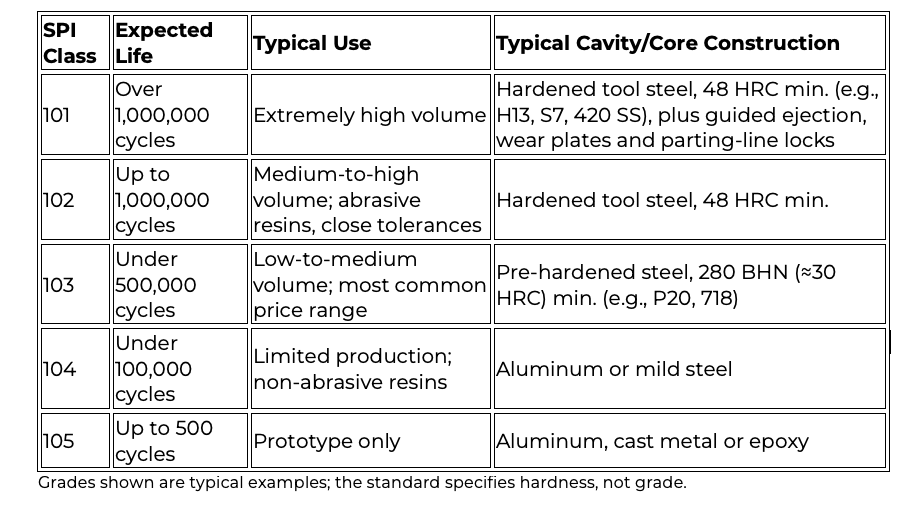
The Plastics Industry Association’s (formerly SPI) mold classes are the industry’s common shorthand for matching tool construction to expected volume:
Engineering and Validation Before Steel Is Cut
The best time to resolve tooling risks is during design review. Changes to a computer-aided design (CAD) file are much faster and less costly than changes to a finished mold.
Part-level guidelines such as wall thickness, draft, and rib design are covered in our post on Design for Manufacturing. On the tooling side, engineering tooling reviews focus on how the mold itself will perform:
Gates and runners: Plan resin delivery for balanced filling, appropriate weld-line placement, and acceptable appearance and strength.
Cooling: Effective channel layout supports optimized cycle times and dimensional stability.
Venting: Provide air escape paths from the mold to reduce the risk of burn marks and short shots.
Ejection and parting lines: Position these features for reliable release and acceptable cosmetics.
Mold-flow analysis supports this engineering review by helping evaluate risks while design changes are still practical. At BRI, we use SOLIDWORKS Plastics Professional for in-house mold-filling simulation to review gate locations, fill patterns, air traps, and weld lines. These results inform tooling decisions before production and help reduce the risk of costly rework later.
Designing “Steel-Safe”
Even the best simulation can’t predict final shrink and warp exactly. That is only known once the first parts are molded and measured. On critical features, the BRI team will ask the tool builder to cut “steel-safe,” so that any correction after sampling removes steel rather than adds it. Removing steel is fast, predictable and inexpensive. Adding it back means welding or a new insert, which is slower and more costly. A weld can also show on polished or textured surfaces and become a failure point over the tool’s life.
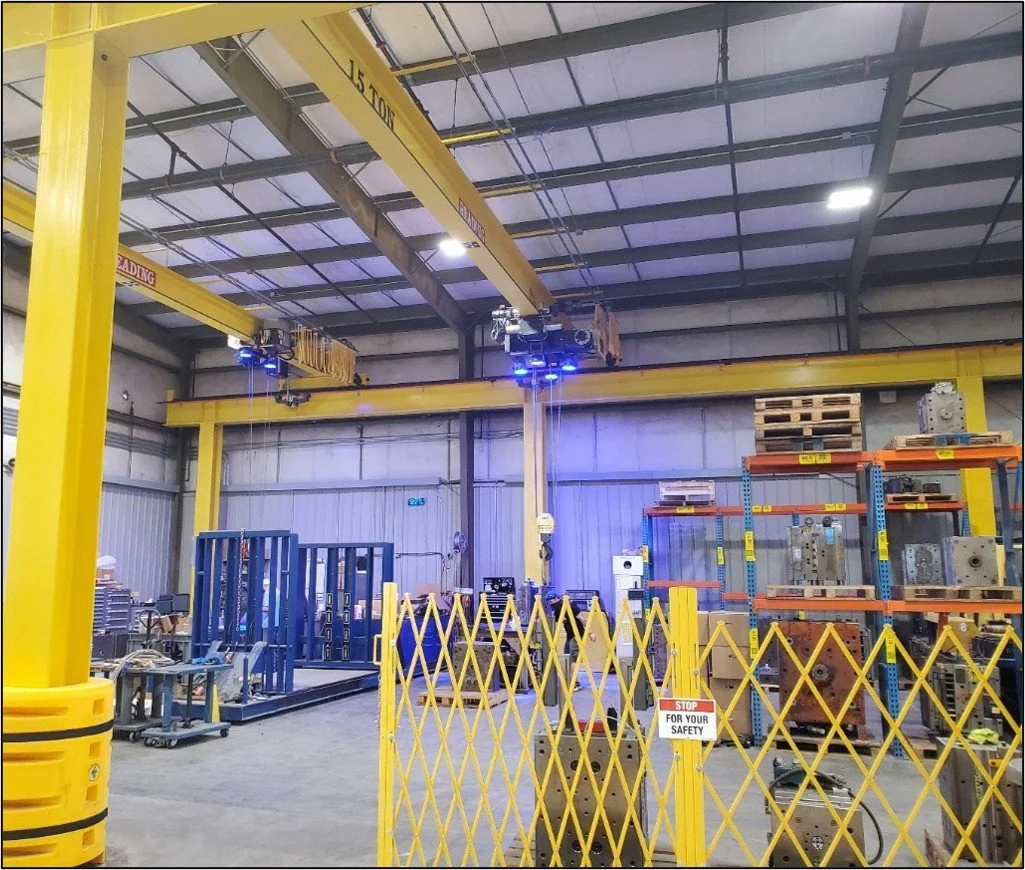
BRI mold shop’s separator and cranes
Building Tools Through Trusted Partners
We source production molds from a vetted network of tool builders in the U.S., Canada and Asia, built to our specifications, so each program goes to the builder whose capability, capacity and cost fit it best. Overseas tooling can have a lower upfront cost but is impacted by tariffs, freight costs, and longer sampling review timelines. Working with tool builders in the U.S. increases real-time collaboration, allows BRI attendance at sampling, and can reduce total cost of ownership through improved access to spares and repairs.
Our team defines what each tool needs to do in production and stays involved as the mold is designed and built. BRI’s standard Tooling RFQ gives every tool builder the critical mold, resin, and press information up front, which shortens quoting and reduces the risk of a missed requirement. BRI’s engineering department maintains mold design guidelines and a mold fabrication checklist so that every mold we source will be complete and ready to run upon arrival at the plant. Our process also includes an internal tool design review with the molding department to ensure nothing is missing. After each sampling, we review part samples against the print and send samples to the customer for their own evaluation.
Tooling Maintenance Over the Life of the Product
A mold must consistently perform for as long as the product is in production. Every cycle puts heat, pressure, and wear on the tool, so regular maintenance is essential to preserving part quality and avoiding unplanned downtime.
Our in-house tool room maintains hundreds of customer molds each year, from high-cavitation tools to conformal-cooled molds and molds with advanced action (e.g., rotating cores). This maintenance work includes cleaning, wear-component inspection, cooling-channel care, lubrication, cycle-based preventive maintenance, mold and hot-runner component replacement, and polishing. The BRI shop uses a large die separator, 15-ton (30,000 lbs.) and 3-ton overhead cranes, and ultrasonic cleaning tanks for deep cleaning areas that hand tools can’t access.
BRI’s DELMIAWorks ERP tracks mold availability, maintenance windows, and changeovers. Real-time monitoring of cycle time, pressure, and scrap can flag process shifts that warrant investigation, helping teams plan maintenance around production and reduce the risk of unexpected downtime.
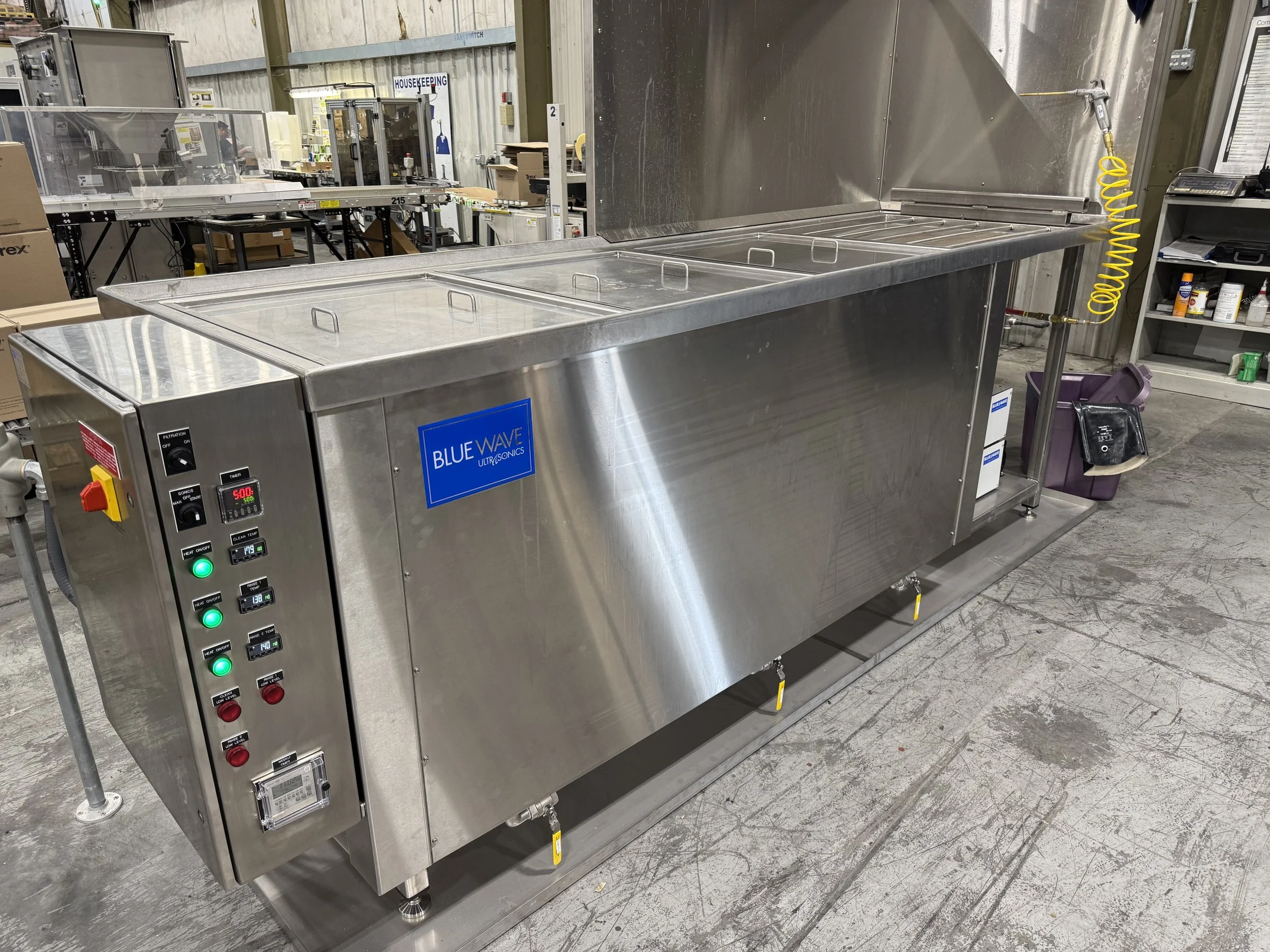
BRI utilizes its Blue Wave Ultrasonic Cleaning System as part of its mold maintenance and repair program.
Getting Tooling Right – From the Start
The right tooling strategy aligns design, resin, volume, and long-term care. Resolving these decisions early helps keep parts consistent and production predictable.
At BRI, production support also extends beyond the mold itself with automated assembly, plastics decorating, and warehousing and fulfillment. Choosing a partner that combines these downstream services with engineering and molding can simplify handoffs throughout a program.
If you are preparing a new part for tooling or want a second look at an existing program, our team can help. Contact us today or request a quote to discuss your project.
FAQs
What is the difference between a multi-cavity mold and a family mold?
A multi-cavity mold produces several identical parts per cycle, while a family mold produces related parts with different geometries in the same shot. For example, a 2+2 mold produces four parts per cycle, two of one geometry and two of another. BRI currently runs molds with up to 64 cavities.
What are SPI mold classes?
SPI mold classes are the Plastics Industry Association’s common shorthand for matching tool construction to expected volume. They range from Class 101, built for over 1,000,000 cycles with hardened tool steel, to Class 105, a prototype-only tool rated for up to 500 cycles.
How does resin choice affect tooling?
Resin properties such as shrink, melt flow, filler content, and corrosivity influence steel selection and mold design. Glass-filled resins are abrasive and increase tool wear, which makes wear resistance, gate design, and maintenance planning especially important.
What is the difference between a hot runner and a cold runner?
Hot runners reduce or eliminate runner scrap and often shorten cycle time, but cost more upfront and add heater and thermocouple maintenance. Cold runners generally cost less and are simpler to maintain.
What does it mean to design a mold “steel-safe”?
Designing steel-safe means cutting critical features so any correction after sampling removes steel rather than adds it. Removing steel is fast, predictable, and inexpensive, while adding it back requires welding or a new insert.
Does BRI build its own molds?
BRI sources production molds from a vetted network of tool builders in the U.S., Canada, and Asia, built to BRI’s specifications. Our team defines tool requirements, reviews tool designs with the molding department, evaluates samples against the print, and maintains molds in our in-house tool room once they are in production.
Should I use a U.S. or overseas tool builder?
It depends on the program. Overseas tooling can have a lower upfront cost but is affected by tariffs, freight, and longer sampling review timelines. U.S. tool builders allow more real-time collaboration, and can reduce total cost of ownership through better access to spares and repairs.
How does BRI maintain molds?
Our in-house tool room maintains hundreds of customer molds each year. That work includes cleaning, wear-component inspection, cooling-channel care, lubrication, preventive maintenance, component replacement, and polishing. Our DELMIAWorks ERP tracks maintenance windows so it can be planned around production.
Authored by Adam Noble, vice president, Blue Ridge Industries- Adam leads a cross-functional operations team in at BRI and sets the company vision and goals to guide the organization toward its 2030 Vision. He uses data and automation to improve efficiency and works with his team to take new products from first customer contact through full production.