The Digital Backbone of High Precision Injection Molding
Not too long ago, on a high‑cavity job, a QA technician caught a non-conforming part during a routine in‑process check. Ten years ago, that single catch would have meant holding the entire work order and hand sorting thousands of parts. Instead, the team at Blue Ridge Industries (BRI) used real‑time production data to bound the defect to a narrow window of suspect product and eliminated more than 650 hours of rework labor – all from one inspection.
That is what high‑precision injection molding looks like today: accuracy in the dimensions of the part, and accuracy in the data behind it. At BRI, the connected system tying planning, production, quality, maintenance, and shipping together is what turns a problem caught at the press into a contained, documented event, not a costly one.
At the heart of that operation lies a manufacturing ERP that serves as a core operational platform – the “single source of truth.” While many facilities rely on generic software to manage their business, high-volume plastics manufacturing requires something far more specialized. By utilizing DELMIAWorks (formerly IQMS), we have moved from basic record keeping to integrated planning, execution, and traceability. This foundation matters most when multiple jobs, materials, and shipping priorities are simultaneously moving.
Managing the Chaos of High-Volume Production
Injection molding at scale is a study in the systematic management and reduction of chaos. On any given day, our facility manages thousands of pounds of raw resin, dozens of active molds, and complex shipping schedules that must perfectly align with our customers’ time requirements. Without a robust digital backbone, this level of complexity can quickly create bottlenecks or quality issues. The most common coordination challenges in high-volume molding include:
Raw materials planning and procurement
Multiple concurrent jobs across presses
Resin families, dryers, and handling requirements
Mold availability, maintenance windows, and changeovers
In-process inspection and documentation requirements
Shipping cadence tied to just-in-time demand
To keep these variables coordinated, we rely on end-to-end traceability and real-time work-in-progress (WIP) control. Our integrated ERP system tracks resin from delivery to our site through shipment as part of a finished component. This end-to-end traceability is a cornerstone of our digital transformation in manufacturing. By automating the tracking of raw materials and WIP inventory, we eliminate the human error inherent in manual logs. This ensures that every part we produce is backed by a traceability record, detailing exactly what went into it and when it was made. But traceability is only part of the picture. Execution also depends on what we can see on the production floor in real time.
The in‑process catch mentioned above is a clean example: using DELMIAWorks RealTime Process Monitoring (RTPM) and ERP traceability features, the team was able to precisely narrow the scope of a material review board event on the high‑cavity job. Rather than applying a broad containment strategy, data‑driven traceability enabled a targeted response with measurable impact:
For molded WIP, the scope of inspection and rework was reduced from 115,000 parts to 55,000 parts, resulting in 83 hours of labor savings.
At a baseline inspection rate of 1 part every 5 seconds, this reduction represents a significant decrease in manual sorting effort.
For finished goods kits, inspection and rework was reduced from 22,000 kits to 5,000 kits, resulting in 567 hours of labor savings.
With each kit requiring approximately 120 seconds to inspect and rework, the benefit of narrowing the suspect window becomes even more pronounced at the finished goods level.
Most importantly, this approach transformed what would traditionally be a full‑scale MRB event into a controlled, time‑bounded containment, preserving both production continuity and labor efficiency.
Real-Time Visibility and Machine Health
The biggest operational benefit, specifically the integration of DELMIAWorks, is found on the production floor. With it, we don’t just look at what happened yesterday; we see what’s happening right now. Through real-time production monitoring, every press in our fleet is connected to a centralized dashboard.
This level of shop-floor transparency allows our technicians to see cycle times and machine performance in real time. If a work center goes down or is no longer within cycle, the system calls the technician on their radio to that specific work center to address the issue. When a monitored parameter drifts outside its control limits, the system instantly flags the anomaly. To detect drift early on our all-electric machines, we monitor key process and material signals, such as:
Cycle time trends
Scrap/reject reasons and rates
Process temperatures by barrel zone (and process water, where applicable); see example below
Fill speeds and times
Pressures
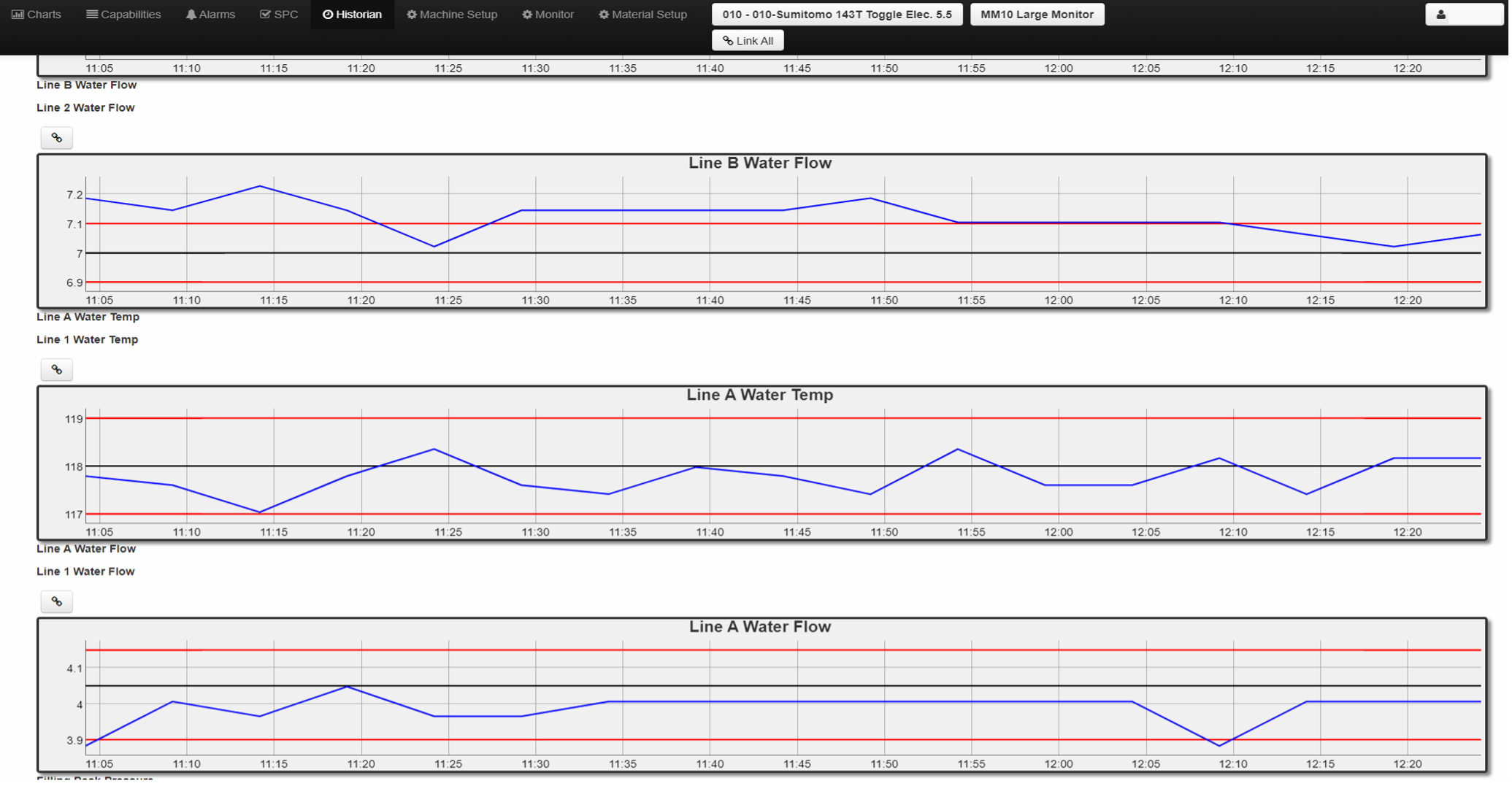
The same real-time data that helps protect uptime also supports documentation, compliance, and faster customer response.
Why Data Management Matters
In late 2025, BRI was recognized for its leadership in the digital space, receiving the DELMIAWorks Excellence Award for how we use that software to drive value for our customers. The specific activities that led to this recognition included our successful migration to the "single source of truth" model, where every department, from engineering to shipping, operates from the same set of live data.
For customers with demanding performance and quality requirements, this capability provides critical assurance. Modern applications require more than consistently produced parts; they require repeatability backed by clear, verifiable data. Whether responding to a customer audit, supporting a corrective action, or validating ongoing process performance, our data management systems deliver structured, reliable documentation that supports transparency and accountability. When information is needed, our ERP allows comprehensive production and quality records to be compiled in seconds rather than days.
When a customer conducts a quality audit, our ERP allows us to pull comprehensive reports in seconds. A typical audit package may include:
Resin lot traceability (e.g., received lot → job/run → shipped product)
Press/mold identification and run history (e.g., dates/times)
Setup verification / parameter record (as applicable)
In-process and final inspection records
Nonconformance records, containment actions, and disposition
Shipment record tied to the production/inspection history
Once that data is structured and consistent across departments, it becomes usable for reporting, as well as prediction and optimization.
The Edge of Industry 4.0 Plastics
The transition to Industry 4.0 plastics is often described as a future goal, but at BRI, we’re practically applying it today. “Smart factory" isn't a buzzword; it’s a facility where the machines communicate with the ERP to monitor and flag their performance. By leveraging predictive analytics, we can plan and perform preventative maintenance during downtime of our choosing, ensuring that our 24/7 operations continue in the most efficient manner possible.
For example, BRI runs millions of pounds of highly abrasive, glass-filled resins per year. Even the best CPM 9V alloy steel screws still wear out over time. The lead time for these high-value screws is long, and they can be significant investments. Stocking spare screws for every press and injection unit would result in hundreds of thousands of dollars of cash tied up in spares inventory sitting on shelves, yet losing a press to a failed screw was also not an option.
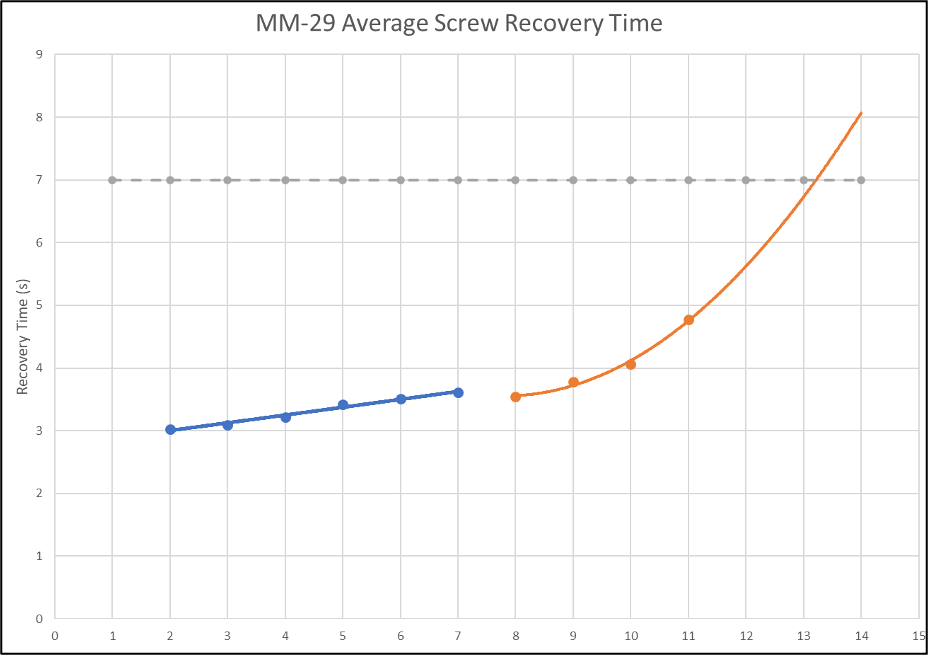
To solve this challenge, BRI utilized RTPM to collect screw recovery times, predicting when the screw recovery time would exceed cooling time (i.e., the point at which screw recovery starts to drive cycle time and increase it over standard). We plotted the appropriate projection curve and determined the screws were providing us with a certain number of months of life. Utilizing the most current screw lead time, we now confidently order screws so that they arrive just before we need them.
This data-enabled operation also impacts our sustainability efforts. By optimizing our startup and shutdown sequences through data-driven insights, we significantly reduce resin waste and energy consumption. Connected operations in manufacturing are as much about waste and energy reduction as they are about profitability. And those same controls extend beyond molding into secondary operations and fulfillment.
Precision Beyond the Press
Our commitment to Industry 4.0 extends into our secondary operations and fulfillment services. When we perform ultrasonic welding or automated assembly, those stations are also integrated into our tracking systems. This ensures that the same level of precision applied to the molding process is maintained through the final packaging and shipment. Taken together, these systems help us run repeatable processes and provide clear records from receipt through shipment.
As we look to the future, it’s clear that our investment in technology is a large part of what keeps us competitive in a global market. We aren't just a plastics company; we are a data-driven contract manufacturing partner. By embracing real-time production monitoring, process monitoring, and a specialized manufacturing ERP, we ensure that BRI remains at the forefront of the industry, delivering the high-precision results our customers expect.
Whether you are looking for a partner to manage a high-volume or a specialized component, the digital backbone of our facility ensures that your project is managed with the highest level of transparency and technical rigor. At BRI, we don't just mold plastic – we mold the future of manufacturing through data.
Authored by Adam Noble, vice president, Blue Ridge Industries - Adam leads a cross-functional operations team in at BRI and sets the company vision and goals to guide the organization toward its 2030 Vision. He uses data and automation to improve efficiency and works with his team to take new products from first customer contact through full production.